



Voltage fluctuations are a common concern for businesses and industries across India. From manufacturing plants and textile units to hospitals, offices, CNC machines, automation systems, and sensitive electronic equipment, unstable voltage can affect equipment performance, increase downtime, and sometimes lead to expensive component failures.
This is where voltage stabilizers become important.
Two technologies commonly considered for voltage regulation are static stabilizers and servo stabilizers. Both are designed to maintain a more stable output voltage, but they use very different technologies to achieve it.
So, which one is better?
The honest answer is: it depends on the application, load characteristics, required response time, accuracy, operating environment, and budget.
In this guide, we will compare static and servo stabilizers in simple terms, explain their features and benefits, and look at practical examples to help you choose the right solution for your application in India.
What Is a Voltage Stabilizer?
A voltage stabilizer is an electrical device designed to maintain the output voltage within a desired range despite variations in the input supply.
For example, suppose an industrial machine requires approximately 415V three-phase supply, but the incoming voltage fluctuates between 360V and 450V.
A suitable stabilizer can regulate the voltage and provide a more stable output to the connected equipment.
Voltage stabilization is particularly useful where equipment is sensitive to:
- Under-voltage
- Over-voltage
- Voltage fluctuations
- Electrical disturbances
- Unstable grid supply
The right stabilizer can help improve equipment reliability and reduce interruptions caused by poor voltage quality.
What Is a Static Stabilizer?
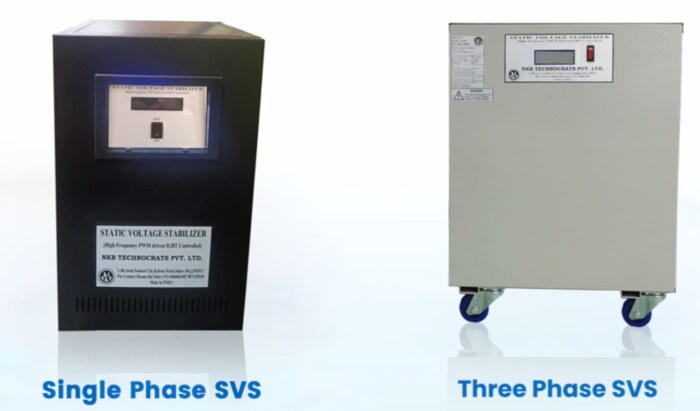
A static stabilizer, also known as a static voltage regulator in some applications, uses power electronic components to regulate voltage without relying on a mechanically moving servo motor.
Instead of physically moving a transformer contact, the system uses electronic switching and control technology to correct the output voltage.
This allows the stabilizer to respond very quickly to changes in input voltage.
Key Features of Static Stabilizers
Some important features include:
- Very fast voltage correction
- No mechanical moving parts
- High regulation accuracy
- Low maintenance requirements
- Silent operation
- Suitable for sensitive electronic loads
- Fast response to sudden voltage changes
- Compact design in many applications
- Suitable for automation and critical loads
Because the voltage correction is electronic, static stabilizers are particularly attractive for applications where even a short voltage disturbance can affect equipment operation.
What Is a Servo Stabilizer?
A servo stabilizer regulates voltage using a servo motor connected to a variable transformer, commonly an autotransformer.
When the input voltage changes, the control circuit detects the variation and operates the servo motor. The motor adjusts the position of the transformer mechanism to bring the output voltage back toward the desired level.
Servo stabilizers have been widely used in Indian industries for many years and remain a popular solution for industrial voltage regulation.
Key Features of Servo Stabilizers
Common features include:
- Proven voltage regulation technology
- Suitable for industrial applications
- Available in a wide range of capacities
- Suitable for heavy loads
- Relatively economical for many applications
- Robust construction
- Available in single-phase and three-phase configurations
- Suitable for manufacturing and commercial applications
Servo stabilizers can be a practical choice when the application does not require extremely fast electronic voltage correction.
Static Stabilizer vs Servo Stabilizer: How Do They Work?
The biggest difference is the method used to correct voltage.
Static Stabilizer
A static stabilizer uses electronic power devices and a control system to regulate voltage.
When the input voltage changes, the electronic control system detects the change and adjusts the output accordingly.
There is no mechanical motor movement involved in the voltage correction process.
Servo Stabilizer
A servo stabilizer uses a servo motor and variable transformer mechanism.
When the input voltage changes:
Input voltage changes → sensing circuit detects variation → control circuit operates servo motor → transformer position changes → output voltage is corrected
Because the servo motor physically moves the mechanism, the correction process is generally slower than electronic static regulation.
Static Stabilizer vs Servo Stabilizer: Key Differences
| Parameter | Static Stabilizer | Servo Stabilizer |
|---|---|---|
| Voltage correction | Electronic | Electromechanical |
| Moving parts | No mechanical moving parts | Servo motor and moving mechanism |
| Response | Very fast | Comparatively slower |
| Maintenance | Generally low | Higher due to moving components |
| Noise | Very low/silent | Some mechanical noise may occur |
| Accuracy | High | High, depending on design |
| Sensitive electronics | Excellent suitability | Suitable, but application dependent |
| Heavy industrial loads | Suitable with correct design | Widely used |
| Mechanical wear | Minimal | Possible over time |
| Installation environment | Suitable for critical applications | Suitable for conventional industrial applications |
| Initial cost | Generally higher | Generally lower |
| Long-term maintenance | Generally lower | Can be higher |
| Best suited for | Critical and sensitive loads | General industrial loads |
The exact performance of either technology depends on the manufacturer’s design, control system, capacity, input range, load characteristics, and installation conditions.
Response Time: One of the Biggest Differences
Response time is one of the most important differences between the two technologies.
Imagine a manufacturing machine operating continuously. The incoming voltage suddenly changes because of a grid disturbance or a large nearby load switching ON.
A static stabilizer can electronically respond to the voltage change very quickly.
A servo stabilizer, on the other hand, needs to physically move the servo motor mechanism to correct the voltage.
This difference can become important when the connected equipment is highly sensitive.
Example
Consider a CNC machine used in a precision manufacturing facility.
If the supply voltage changes suddenly, the machine may experience an alarm, control-system disturbance, or interruption depending on the severity and duration of the voltage event.
For such applications, the fast response characteristics of a static stabilizer can be a significant advantage.
Maintenance Comparison
Maintenance is another important factor when choosing between static and servo technology.
Static Stabilizer Maintenance
Since static stabilizers do not depend on mechanical motor movement for voltage correction, there are fewer mechanical components that require routine servicing.
Maintenance may primarily involve:
- Electrical connections
- Cooling system
- Power electronic components
- Control electronics
- Protection circuits
- Periodic inspection
Servo Stabilizer Maintenance
Servo stabilizers contain mechanical components such as:
- Servo motor
- Moving contacts
- Carbon brushes or related contact mechanisms
- Variable transformer mechanism
These components can require inspection and maintenance over time.
For an industrial facility operating continuously, maintenance requirements should therefore be considered along with the initial purchase price.
Which One Is More Energy Efficient?
It is not correct to say that every static stabilizer is automatically more efficient than every servo stabilizer.
Efficiency depends on the actual design, load level, input voltage range, transformer losses, switching technology, cooling system, and operating conditions.
However, modern static stabilizers can offer highly efficient electronic voltage regulation, while servo stabilizers have transformer and mechanical losses associated with their design.
When comparing products, look at the actual efficiency specification from the manufacturer, rather than selecting a technology based only on its name.
Static Stabilizer: Major Benefits
A static stabilizer can offer several advantages for applications where fast and precise voltage regulation is important.
1. Extremely Fast Voltage Correction
Electronic control allows rapid correction of voltage variations.
This is particularly valuable for sensitive equipment.
2. No Mechanical Moving Parts
The absence of a servo motor and mechanical adjustment mechanism reduces mechanical wear.
3. Low Maintenance
With fewer mechanical components, routine maintenance can be simpler.
4. Suitable for Sensitive Equipment
Static stabilizers can be suitable for:
- CNC machines
- Automation systems
- Medical equipment
- Control systems
- Communication equipment
- Industrial electronics
- Data and IT equipment
The suitability should always be confirmed based on the equipment’s electrical requirements.
5. Quiet Operation
Since there is no servo motor continuously moving to regulate voltage, static stabilizers can provide very quiet operation.
6. Fast Dynamic Response
This is one of the biggest reasons industries consider static technology for critical applications.
Servo Stabilizer: Major Benefits
Servo stabilizers also have several advantages and remain a practical choice for many Indian industrial applications.
1. Proven Technology
Servo stabilization has been used extensively across industrial and commercial applications.
2. Wide Capacity Availability
Servo stabilizers are available across a broad range of capacities, making them suitable for many types of electrical loads.
3. Suitable for Industrial Loads
They can be used for:
- Manufacturing machines
- Textile machinery
- Packaging machines
- Injection molding machines
- Pumps
- Motors
- Commercial electrical systems
- General industrial loads
4. Cost-Effective for Many Applications
Where ultra-fast correction is not essential, a servo stabilizer can provide an economical voltage regulation solution.
5. Simple Operating Concept
The technology is relatively easy for many maintenance teams to understand and service.
Which Is Better for Industrial Applications in India?
There is no universal winner. The better choice depends on the application.
Choose a Static Stabilizer When:
A static stabilizer may be preferable when you have:
- Sensitive electronic equipment
- Automation systems
- CNC machines
- Critical control systems
- Rapidly changing loads
- A requirement for very fast voltage correction
- A strong focus on low mechanical maintenance
- Equipment where voltage disturbances can cause significant downtime
Choose a Servo Stabilizer When:
A servo stabilizer may be appropriate when you have:
- Conventional industrial machinery
- Motors and general industrial loads
- Stable but fluctuating grid voltage
- Less demanding response-time requirements
- A cost-sensitive project
- Existing maintenance infrastructure for servo stabilizers
Example 1: Textile Manufacturing Unit
Suppose a textile factory has several machines operating simultaneously. The facility experiences regular voltage fluctuations during peak operating hours.
The equipment includes motors and conventional industrial machinery.
For such an application, a properly sized servo stabilizer can be a practical and economical solution.
However, if the factory also operates sensitive electronic control systems, automation equipment, or high-value machines requiring rapid voltage correction, a static stabilizer may provide additional advantages.
Example 2: CNC Machine Shop
Consider a precision engineering company operating multiple CNC machines. CNC machines contain sensitive electronic controls and drive systems.
In this situation, voltage regulation speed and stability can be particularly important.
A static stabilizer can be attractive because of its fast electronic response and lack of mechanical movement.
For critical CNC applications, the stabilizer should be selected based on the CNC manufacturer’s voltage tolerance, starting current, harmonic environment, and total connected load.
Example 3: Hospital
Hospitals may operate equipment where reliable power quality is extremely important. Medical equipment, laboratory systems, imaging equipment, control systems, and IT infrastructure can have different electrical requirements.
A static stabilizer can be considered for sensitive loads where fast voltage correction is important.
However, a stabilizer should not be treated as a replacement for a UPS where uninterrupted power is required.
A UPS and a stabilizer perform different functions.
Example 4: Commercial Building
Consider an office building with:
- Computers
- Lighting
- Air-conditioning
- Networking equipment
- Printers
- General electrical loads
If the main concern is moderate voltage fluctuation and the loads are not extremely sensitive, a properly designed servo stabilizer may be sufficient. If there are highly sensitive IT or electronic loads, other power-quality solutions may also need to be considered.
Static Stabilizer vs Servo Stabilizer for Solar Applications
India’s solar market is expanding rapidly, and voltage regulation can also become relevant in solar power systems. Solar installations may include:
- Grid-connected inverters
- Hybrid inverters
- Monitoring systems
- Transformers
- AC distribution equipment
- Industrial loads
A stabilizer should not automatically be installed simply because a solar system is present.
The actual requirement depends on the grid conditions, inverter operating range, load characteristics, interconnection design, and applicable utility requirements.
For sensitive inverter or control applications where rapid voltage correction is required, static technology may be considered.
For broader industrial applications where cost and conventional voltage regulation are major considerations, servo technology may remain suitable.
Important Factors to Consider Before Buying a Stabilizer
Choosing a stabilizer only by price or kVA rating can lead to problems. Consider these factors before making a purchase.
1. Input Voltage Range
Determine the minimum and maximum incoming voltage.
For example:
Input: 300–470V
The stabilizer must be capable of handling the actual site voltage range.
2. Required Output Voltage
The required output may be:
- 230V single phase
- 415V three phase
- Another application-specific voltage
The output tolerance should match the connected equipment.
3. Total Load
Calculate the connected load in kW or kVA. Don’t select a stabilizer solely based on the average running load. Consider:
- Starting current
- Motor loads
- Inrush current
- Future expansion
- Peak demand
4. Load Type
Identify whether your load consists mainly of:
- Motors
- Heaters
- Electronics
- CNC machines
- Drives
- Transformers
- Computers
- Medical equipment
- Industrial automation
Different loads can behave very differently during voltage fluctuations.
5. Response Time
If the application involves sensitive electronics or rapidly changing voltage conditions, response time becomes particularly important.
6. Regulation Accuracy
Check the manufacturer’s actual output regulation specification.
7. Efficiency
Compare actual efficiency figures rather than relying on general assumptions about technology.
8. Protection Features
Look for appropriate protection against conditions such as:
- Over-voltage
- Under-voltage
- Overload
- Short circuit
- Over-temperature
- Phase failure
- Phase sequence issues
The exact protection package varies by product.
9. Bypass Facility
For industrial applications, a bypass arrangement can be useful during maintenance or certain operating conditions.
10. After-Sales Service
This is especially important for industrial equipment. A low-cost stabilizer may not be the best investment if technical support and spare parts are difficult to obtain.
Static Stabilizer vs Servo Stabilizer: Cost Consideration
Initial purchase cost is often one of the first questions asked by customers. In many cases, servo stabilizers have a lower initial cost compared with advanced static stabilizer systems.
Static stabilizers can have a higher upfront cost because they use power electronic components and sophisticated control systems.
But the purchase price should not be the only consideration. Think about the total cost of ownership:
Purchase cost + installation + maintenance + downtime risk + energy losses + component replacement + expected operating life
For a critical production line, even a small reduction in downtime can have a much larger financial impact than the initial difference in stabilizer price.
Can a Static Stabilizer Replace a Servo Stabilizer?
In many applications, yes, but not always. A static stabilizer can perform the voltage regulation function required by many applications, but whether it is a suitable replacement depends on:
- Load type
- Capacity
- Input voltage range
- Output requirements
- Response time
- Harmonics
- Inrush current
- Operating environment
- Budget
- Required protection
Therefore, replacing an existing servo stabilizer with a static stabilizer should be based on an electrical assessment rather than simply choosing the newer technology.
Common Mistakes When Selecting a Voltage Stabilizer
Mistake 1: Selecting Only by kVA
Two 100 kVA loads can have completely different characteristics.
A motor-heavy load and an electronic load may require different considerations.
Mistake 2: Ignoring Starting Current
Motors, compressors, pumps and certain industrial machines can draw significantly higher current during starting.
Mistake 3: Looking Only at Purchase Price
A cheaper product may not necessarily provide the lowest overall cost.
Mistake 4: Ignoring Input Voltage Conditions
The stabilizer should be selected based on actual site measurements.
Mistake 5: Assuming Stabilizer Means Backup Power
A stabilizer regulates voltage. It does not automatically provide battery backup. If uninterrupted power is required, a UPS or another suitable backup system may be necessary.
Static Stabilizer vs Servo Stabilizer: Quick Decision Guide
If your priority is very fast voltage correction, consider a static stabilizer. If your priority is a proven and economical solution for conventional industrial loads, a servo stabilizer may be suitable.
If your load contains highly sensitive electronic equipment, static technology deserves serious consideration.
If your application involves general-purpose industrial machinery, servo stabilization may provide a cost-effective solution.
If maintenance and mechanical wear are major concerns, static stabilization has an advantage because it does not depend on a moving servo mechanism for voltage correction.
Frequently Asked Questions
Is a static stabilizer better than a servo stabilizer?
Not in every situation. Static stabilizers generally offer faster electronic voltage correction and no mechanical moving parts, while servo stabilizers can be more economical and are widely used for conventional industrial loads.
Which stabilizer is better for CNC machines?
A static stabilizer can be a strong option for CNC machines because of its fast response and suitability for sensitive electronic systems. However, the final selection should be based on the CNC machine’s electrical specifications and site conditions.
Which is cheaper: static or servo stabilizer?
In many applications, servo stabilizers have a lower initial purchase cost. Static stabilizers may cost more initially because of their electronic architecture. However, total cost of ownership should also be considered.
Does a static stabilizer require maintenance?
Yes. Although it has no mechanical servo mechanism, it still requires periodic inspection of electrical connections, cooling, electronic components and protection systems.
Does a servo stabilizer have moving parts?
Yes. A servo stabilizer uses a motor-driven mechanism to adjust the voltage, so mechanical components require periodic inspection and maintenance.
Can a stabilizer protect equipment from power cuts?
No. A voltage stabilizer is primarily designed to regulate voltage. It does not provide uninterrupted backup power like a UPS or battery system.
How do I select the correct stabilizer capacity?
Start by calculating the connected load in kW/kVA and then consider motor starting current, inrush current, input voltage range, load characteristics, future expansion and required operating margin.
Final Verdict: Static or Servo Stabilizer?
The choice between a static stabilizer and servo stabilizer should be based on the actual application rather than simply choosing the latest technology.
Static Stabilizer
Best when you need:
- Very fast response
- High-performance voltage regulation
- Low mechanical maintenance
- Quiet operation
- Protection for sensitive electronic equipment
Servo Stabilizer
Best when you need:
- Proven voltage regulation technology
- Cost-effective industrial stabilization
- A solution for conventional industrial loads
- Wide capacity options
- A familiar technology for industrial maintenance teams
In simple terms, static stabilizers are particularly attractive for fast, sensitive and critical applications, while servo stabilizers remain a practical and economical choice for many conventional industrial applications.
The right stabilizer is ultimately the one that matches your load, voltage conditions, response-time requirements, budget and operating environment.
Before purchasing, it is always advisable to conduct a site assessment and review actual voltage fluctuation data. A proper technical evaluation can help you avoid both under-sizing and unnecessary investment.
If you are evaluating a static or servo stabilizer for an industrial facility, compare the input range, output accuracy, response time, efficiency, overload capacity, protection features, maintenance requirements, warranty and after-sales support, not just the price tag.
Post a comment
Related Posts
July 1, 2026
Benefits of Static Stabilizer for Energy Consumption: Save Power, Protect Equipment & Improve Efficiency
Electricity is the backbone of every modern home, commercial building, and industrial facility. However, unstable…