

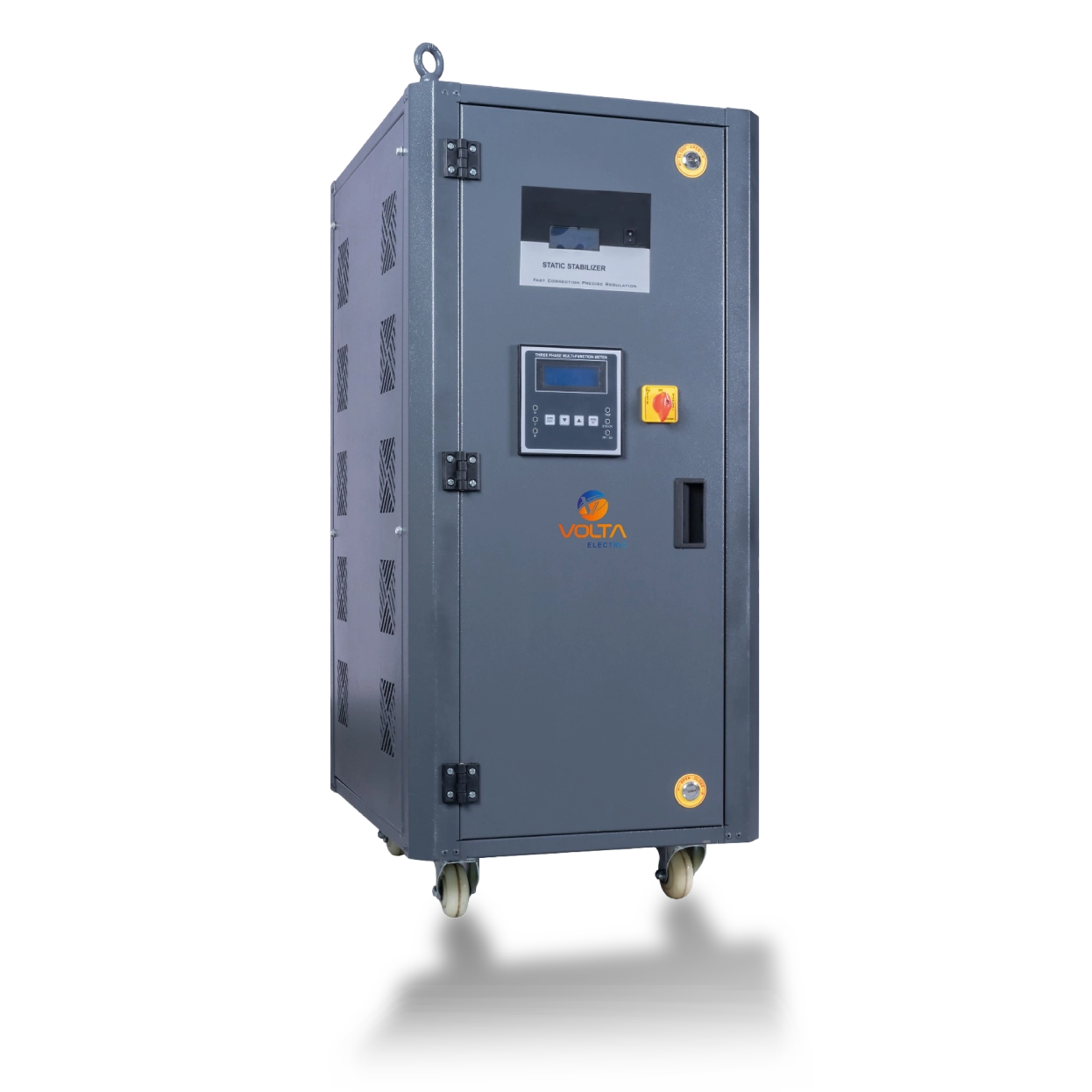
Static Stabilizer
Static stabilizers from Volta Green Energy Pvt. Ltd. deliver rock-solid voltage regulation across a huge range of capacities of 3-Phase systems from 10 kVA to 200 KVA .So, your sensitive equipment always gets the steady power it deserves.

Quick Response
Corrects voltage in under 20 ms, contactless & reliable.
Air Cooled
Efficient, silent operation with natural cooling.
Accurate Control
DSP-based system maintains voltage within ±1%.
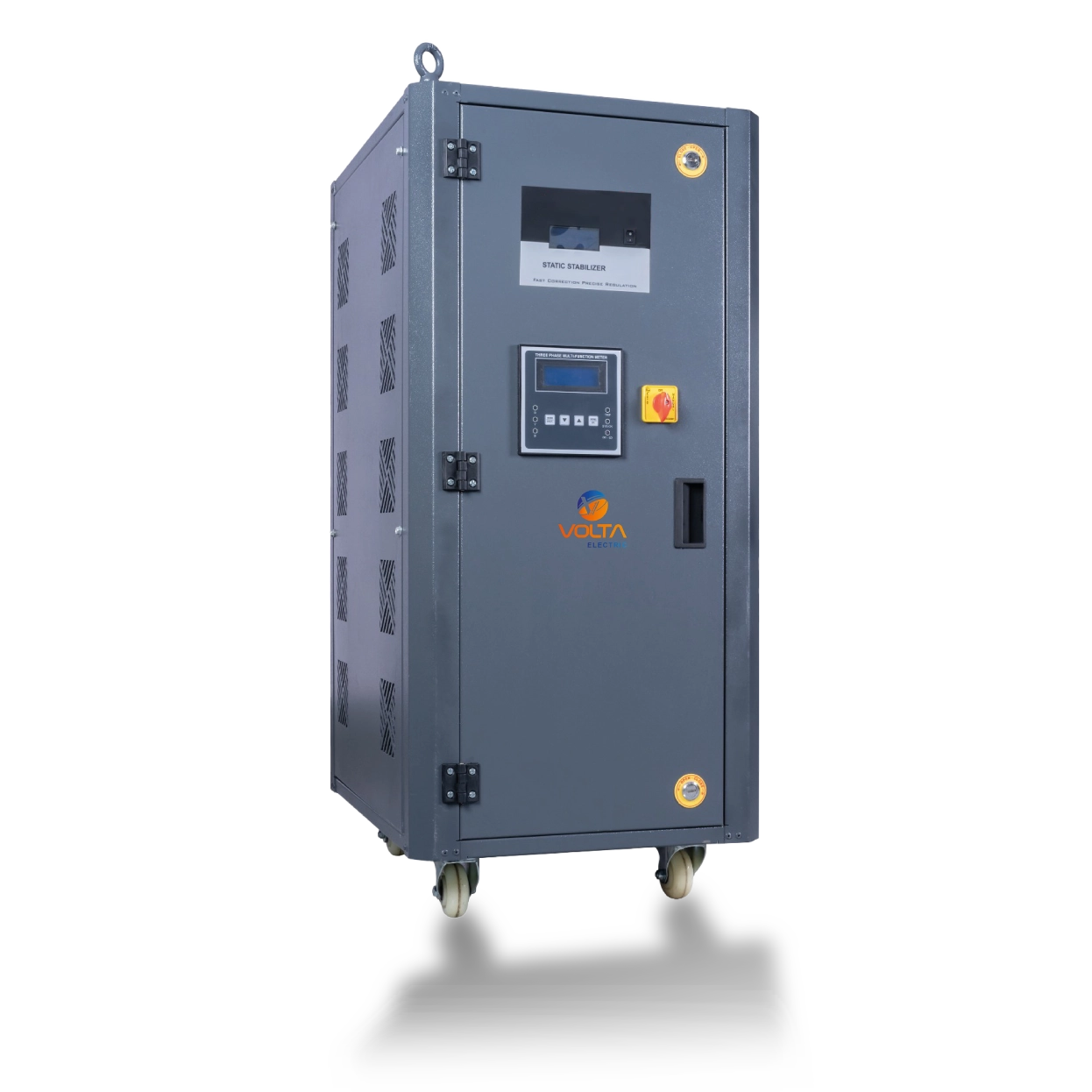
10KVA–60KVA Static Stabilizer
Three Phase | Air Cooled | VGES -
10 / 15 / 20 / 25 / 30 / 40 / 50 / 60 KVA
Microprocessor-Based Regulation
Silent Static Operation
High Voltage Accuracy ±1%
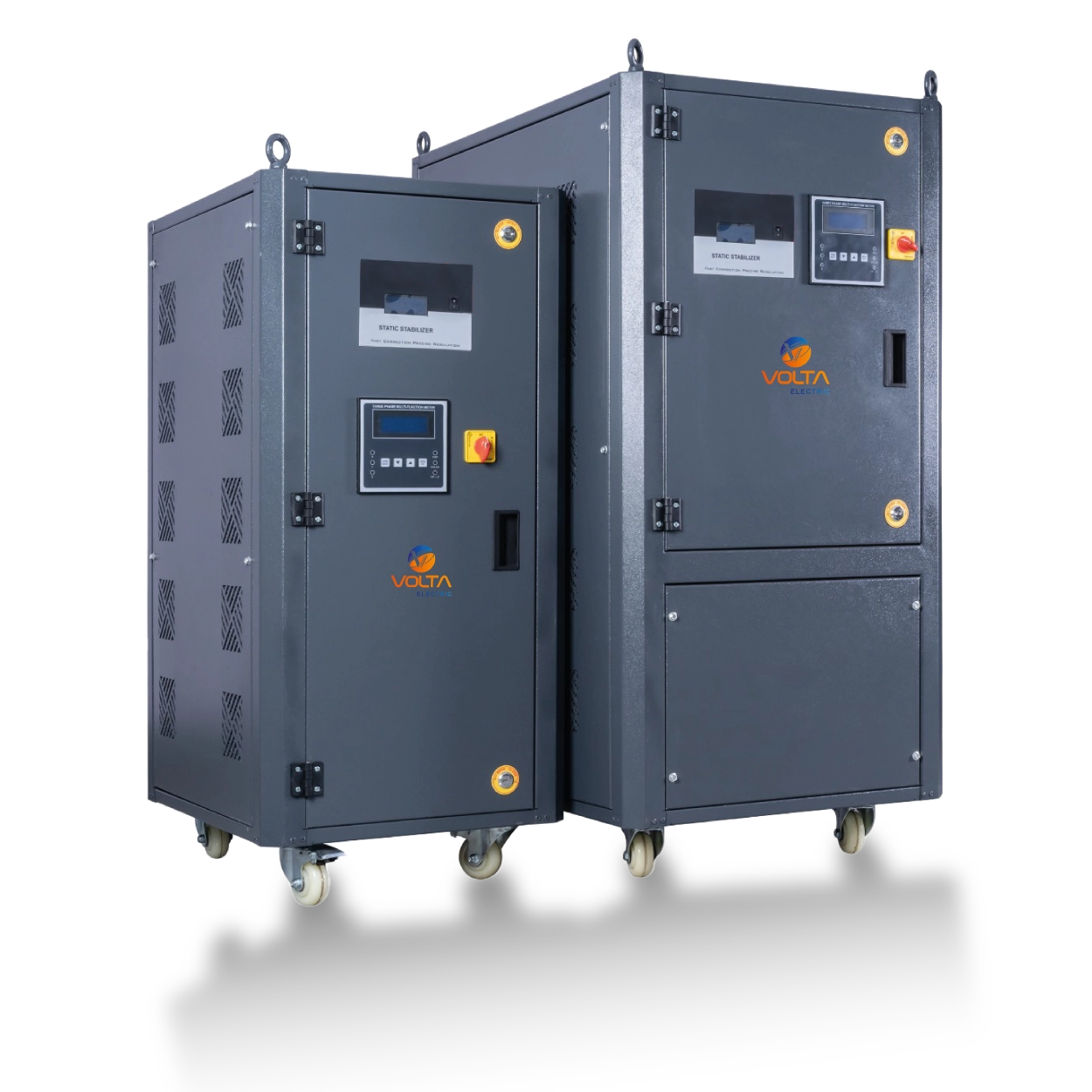
60KVA–200KVA Static Stabilizer
Three Phase | Air Cooled | VGES -
60 / 75 / 100 / 125 / 150 / 175 / 200 KVA
Fast Correction Speed
Pure Sinewave Output
Maintenance-Free Operation
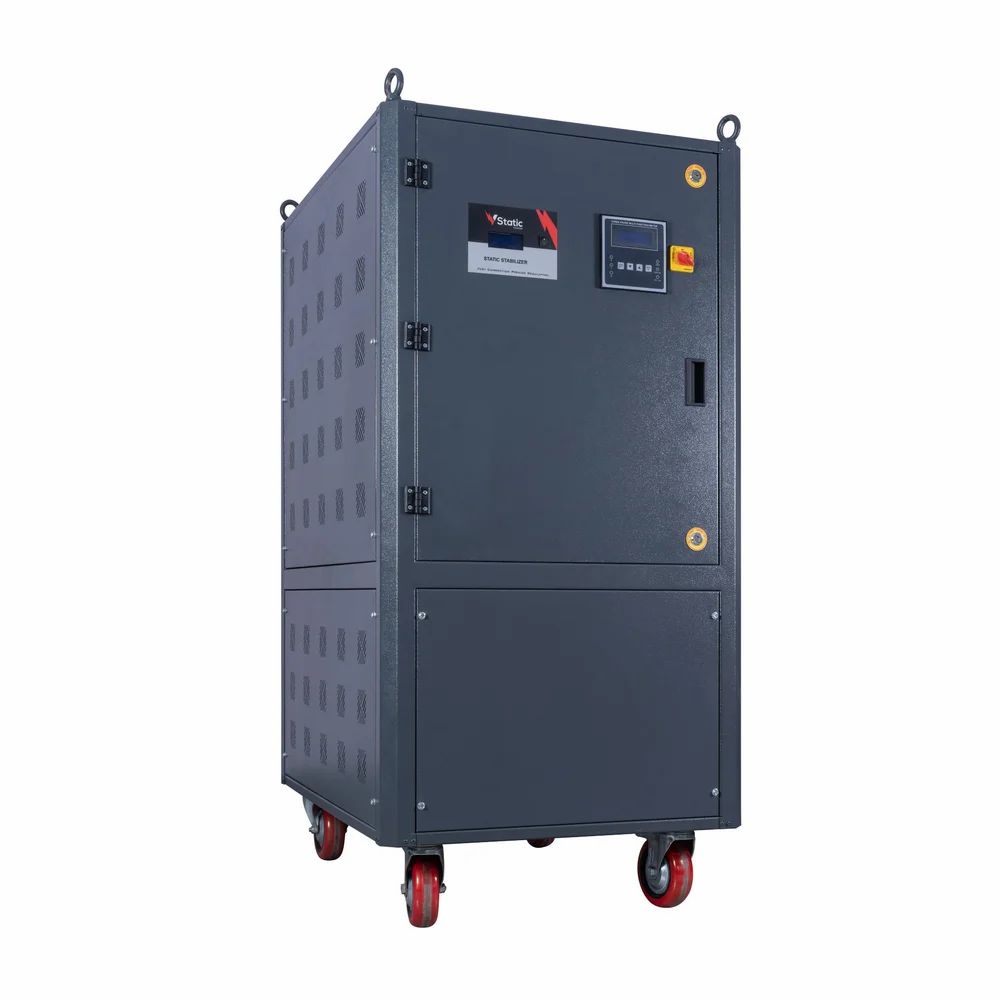
Static Stabilizer
Static stabilizers from Volta Green Energy Pvt. Ltd. deliver rock-solid voltage regulation across a huge range of capacities of 3-Phase systems from 10 kVA to 200 KVA .So, your sensitive equipment always gets the steady power it deserves.
Range
3 Phase – Air Cool (10 KVA to 60 KVA)
3 Phase – Oil Cool (60 KVA to 200 KVA)
Accurate Control
DSP-based system maintains voltage within ±1%.
Quick Response
Corrects voltage in under 20 ms, contactless & reliable.
Air Cooled
Efficient, silent operation with natural cooling.
Got Questions?
We are here to assist you. Feel free to call or email us with any solar-related queries at any time.
+91 72280 10925
[email protected]
Static Stabilizer for B2B Businesses in Kanpur
Advanced Static Voltage Stabilizers for Industries and Businesses in Kanpur
For any business that depends on electrical machinery, maintaining a stable power supply is essential for smooth operations. In Kanpur, where leather processing, textile manufacturing, engineering workshops, packaging units, and other industrial activities play an important role in the local economy, voltage fluctuations can create unnecessary operational challenges.
A sudden change in voltage may interrupt production, affect electronic control systems, or cause sensitive equipment to operate outside its specified limits. For businesses working with automated machinery and precision equipment, these issues can result in downtime, maintenance expenses, and delays in fulfilling customer orders.
Volta Green Energy Pvt. Ltd. offers static stabilizer solutions designed to provide fast and precise voltage regulation for suitable industrial and commercial applications. Using solid-state electronic control technology, static stabilizers help maintain a stable output voltage within the specified operating range of the selected model.
Whether you operate a leather-processing unit in Jajmau, a manufacturing facility in Panki, a textile or engineering business in Dada Nagar, or a commercial establishment in Kanpur city, choosing the right static voltage stabilizer can help support reliable equipment performance.
What Is a Static Stabilizer?
A static stabilizer is an electronic voltage regulation device that monitors incoming voltage and corrects variations using semiconductor-based power electronics and electronic control circuits.
Unlike a conventional servo stabilizer, which uses a motor-driven mechanical mechanism to adjust voltage, a static stabilizer performs voltage correction electronically. This design can provide faster voltage correction and eliminates the motor-driven mechanism used for voltage adjustment in servo stabilizers.
For businesses in Kanpur, static stabilizers can be useful where sensitive electronic equipment, automated production systems, and industrial machinery require accurate voltage regulation.
Volta Green Energy’s referenced product range includes three-phase static stabilizers from 10 kVA to 200 kVA, with air-cooled configurations and other options depending on the selected model. The appropriate capacity depends on the connected load, input voltage conditions, and requirements of the application.
Why Do Businesses in Kanpur Need Static Stabilizers?
Kanpur has a diverse industrial base that includes leather processing, textiles, engineering, manufacturing, packaging, healthcare, and commercial services. These businesses often depend on electrical equipment that must operate within defined voltage limits.
For example, a leather-processing unit may use pumps, motors, conveyors, and process-control systems. A textile facility may operate production machinery for long hours, while an engineering workshop may depend on CNC machines and electronically controlled equipment.
When the incoming voltage varies beyond acceptable limits, businesses may experience:
Unexpected machine shutdowns and production interruptions.
Malfunctions in PLCs, controllers, and electronic control panels.
Unstable operation of precision equipment.
Increased troubleshooting and maintenance requirements.
Interruptions to manufacturing, processing, and packaging activities.
Potential damage to connected equipment during abnormal voltage conditions.
Delays in production schedules and customer deliveries.
A properly selected static stabilizer helps regulate voltage within its designed operating limits. This can reduce problems associated with voltage fluctuations, although actual performance depends on the incoming supply, connected load, and stabilizer specifications.
It is also important to understand that a static stabilizer does not provide backup electricity during a complete power failure. Businesses that require uninterrupted operation may need a UPS, generator, or another suitable backup system.
Key Benefits of Static Stabilizers for Kanpur Industries
1. Fast Voltage Correction
Static stabilizers use electronic power regulation technology to respond rapidly to changes in incoming voltage. Depending on the model and operating conditions, voltage correction may take place within milliseconds.
This is particularly useful for industrial applications where voltage disturbances can affect sensitive electronics, automated control systems, and production equipment.
2. Precise Voltage Regulation
Electrical equipment generally performs best when supplied with voltage within its specified operating range. Volta’s referenced static stabilizer specifications include digital signal processor (DSP)-based control with regulation accuracy of up to ±1% under specified conditions.
The actual regulation accuracy should be confirmed against the selected model’s datasheet and operating conditions.
3. Reduced Mechanical Maintenance
Static stabilizers do not use the motor-driven mechanical voltage-adjustment mechanism found in conventional servo stabilizers. This reduces maintenance associated with those moving voltage-correction components.
However, electronic components, cooling arrangements, electrical connections, and protection systems still require appropriate inspection and maintenance.
4. Support for Sensitive Equipment
Many industrial facilities use electronic controllers, automation systems, laboratory instruments, and precision machinery that require stable electrical input.
A suitably selected static stabilizer can help maintain voltage within the required limits for compatible equipment, supporting dependable operation.
5. Reduced Voltage-Related Downtime
In a busy manufacturing environment, even a short interruption can affect production schedules. Repeated machine restarts, troubleshooting, and process interruptions may increase operating costs.
A suitable static stabilizer can help reduce interruptions caused by voltage variations and support more consistent equipment operation.
6. Compact Design and Suitable Cooling Options
Depending on the model, static stabilizers can offer compact installation arrangements and air-cooled configurations. These may be useful for industrial premises where installation space and maintenance access are important considerations.
The selected unit should have adequate ventilation and suitable protection against dust, heat, and other environmental conditions.
7. Long-Term Operational Value
The value of a voltage stabilizer is not limited to its purchase price. Businesses should also consider maintenance requirements, equipment compatibility, operating conditions, and the potential cost of voltage-related interruptions.
Selecting the correct capacity and configuration can help businesses make a more informed investment in electrical reliability.
Key Features to Look for in a Static Voltage Stabilizer
When selecting a static stabilizer in Kanpur, it is important to compare technical specifications with the actual requirements of your facility.
Advanced Solid-State Technology
Electronic voltage regulation allows the stabilizer to correct supply variations without relying on a motor-driven mechanical adjustment mechanism.
This can be beneficial where quick voltage correction is an important requirement.
Digital Control System
A digital or DSP-based control system monitors electrical conditions and manages voltage correction. Depending on the model, it may also support operating status indications, fault monitoring, and protective functions.
Fast Response Time
Some static stabilizers are designed to correct voltage variations within milliseconds. Always verify the specified response time and the conditions under which it is measured before selecting a model for sensitive machinery.
Suitable Input Voltage Range
The stabilizer should accommodate the voltage fluctuations experienced at your premises. Check its permissible input voltage range and confirm whether output capacity or regulation accuracy changes at extreme input voltages.
Appropriate Overload Capability
Motors, compressors, pumps, and other industrial equipment may draw higher current during startup. The stabilizer should be selected after considering starting current, overload duration, and the characteristics of the connected load.
Cooling and Installation Requirements
Consider the available installation space, ventilation, ambient temperature, dust exposure, and accessibility for servicing. Proper installation and cooling help support reliable operation.
Protection Functions
Depending on the model, protection features may include overvoltage, undervoltage, overload, short-circuit, phase-failure, and overtemperature protection. Confirm the included functions before purchasing.
Static Stabilizer Models and Capacity Options
Volta Green Energy’s referenced product range covers three-phase static stabilizers in the following capacity groups.
| Product category | Capacity options |
|---|---|
| Three-phase, air-cooled static stabilizer | 10, 15, 20, 25, 30, 40, 50 and 60 kVA |
| Three-phase static stabilizer, higher-capacity range | 60, 75, 100, 125, 150, 175 and 200 kVA |
Cooling arrangements, protection functions, and electrical specifications may vary by model. Contact Volta Green Energy to confirm current availability and the configuration suitable for your application.
How Much Static Stabilizer Capacity Does Your Business Need?
Choosing the right capacity is an important step in protecting equipment and maintaining dependable operations. The stabilizer must handle the connected load while accounting for power factor, starting current, input voltage variations, and operating conditions.
The following ranges are indicative starting points rather than final sizing recommendations.
| Application | Capacity range to assess |
|---|---|
| Small commercial equipment or selected sensitive loads | 10–20 kVA |
| Workshops and smaller production equipment | 20–30 kVA |
| Medium-sized machinery and commercial loads | 30–60 kVA |
| Larger industrial equipment and grouped loads | 75–100 kVA |
| Higher-demand industrial installations | 125–200 kVA |
For example, a machine rated at 30 kW does not automatically require a 30 kVA stabilizer. The actual requirement depends on power factor, efficiency, starting current, and the characteristics of the electrical load.
For facilities with multiple machines, a qualified electrical professional should calculate the total demand and determine the appropriate stabilizer capacity.
Essential Protection Features for Industrial Applications
A static stabilizer should include protection functions suitable for the equipment it supplies and the electrical conditions at the installation site.
| Protection feature | Purpose |
|---|---|
| Overvoltage protection | Helps protect connected loads against excessive output voltage. |
| Undervoltage protection | Helps prevent operation outside permitted low-voltage limits. |
| Overload protection | Responds when the connected load exceeds specified limits. |
| Short-circuit protection | Supports a safe response to short-circuit conditions as designed. |
| Phase-failure protection | Detects a missing phase in applicable three-phase systems. |
| Phase-sequence protection | Identifies incorrect phase sequence where supported. |
| Overtemperature protection | Helps prevent operation beyond specified thermal limits. |
| Input supply monitoring | Monitors incoming electrical conditions. |
| Surge protection | Addresses specified transient overvoltage events when included in the design. |
Not every static stabilizer includes all these features. Verify the protection package against the approved technical datasheet before purchasing.
Suitable earthing, circuit protection, and external surge protection may also be required, depending on site conditions. A static stabilizer does not automatically resolve all power quality problems, such as harmonic distortion, frequency variation, or complete power failure.
Applications of Static Stabilizers Across Kanpur
Leather Processing Units in Jajmau
Kanpur’s leather industry uses a variety of pumps, motors, processing equipment, conveyors, and electronic control systems.
Voltage fluctuations can affect compatible machinery and control equipment, potentially interrupting production. A suitably rated static stabilizer can help maintain voltage within specified limits for connected loads.
Industrial Facilities in Panki
Manufacturing and industrial facilities may operate production machinery, electrical panels, compressors, pumps, and automation systems.
A static stabilizer can be considered for equipment that requires fast voltage correction or more precise voltage regulation. Proper sizing is particularly important where multiple machines operate simultaneously.
Textile and Engineering Units in Dada Nagar
Textile-related operations and engineering workshops may use motors, machine controls, processing equipment, and precision tools.
A suitable static stabilizer can help maintain a consistent voltage supply for compatible equipment and reduce disturbances associated with incoming voltage fluctuations.
Manufacturing and Packaging Businesses
Manufacturing and packaging facilities often depend on filling machines, conveyors, sealing equipment, production controls, and electronic instrumentation.
Voltage regulation can support reliable operation, provided the stabilizer is correctly selected for the equipment’s electrical characteristics and operating cycle.
Hospitals and Diagnostic Centres
Hospitals, clinics, and diagnostic facilities use laboratory instruments, monitoring devices, diagnostic systems, and other sensitive electrical equipment.
These applications require careful consideration of voltage accuracy, electrical safety, and equipment manufacturers’ requirements. Critical medical equipment may also require a dedicated UPS or backup supply.
Commercial Buildings and Offices
Offices, retail establishments, educational institutions, and commercial buildings may operate computers, networking equipment, access control systems, and electronic controls.
A static stabilizer can be considered where voltage regulation is needed for compatible equipment. Larger buildings may require separate stabilizers for particular load groups rather than one unit for the entire facility.
Warehouses and Logistics Facilities
Warehouses and distribution centres may depend on conveyors, material-handling equipment, electronic controls, and IT infrastructure.
A suitable voltage regulation solution can help support reliable equipment operation, particularly where voltage disturbances contribute to unexpected interruptions.
Laboratories and Testing Facilities
Testing and laboratory equipment may require a stable electrical supply to operate within specified limits.
A correctly selected static stabilizer can help maintain voltage within the required range. Equipment sensitivity, grounding requirements, and additional power quality needs should be evaluated before installation.
Static Stabilizer vs. Servo Stabilizer
Static and servo stabilizers both regulate voltage, but they use different technologies. Understanding these differences can help businesses select the appropriate solution.
| Parameter | Static stabilizer | Servo stabilizer |
|---|---|---|
| Voltage correction | Electronic, solid-state regulation | Motor-driven mechanical regulation |
| Response speed | Can provide correction within milliseconds, depending on design | Generally slower, depending on design |
| Mechanical voltage-correction parts | No motor-driven correction mechanism | Uses moving mechanical components |
| Maintenance | Lower mechanical maintenance requirements | Requires maintenance of mechanical components |
| Voltage accuracy | Depends on model and operating conditions | Depends on model and operating conditions |
| Suitable applications | Loads where fast correction is important | Many general industrial and commercial loads |
| Initial investment | May be higher for some configurations | May be more economical for some applications |
A static stabilizer may be preferable when rapid electronic correction and reduced mechanical maintenance are priorities. A servo stabilizer can remain a suitable choice for many general-purpose industrial applications.
The final decision should be based on connected load, input voltage conditions, required regulation accuracy, response time, and total cost of ownership.
How to Choose the Right Static Stabilizer in Kanpur
Before purchasing a static voltage stabilizer, assess your facility’s electrical conditions and operating requirements.
Measure incoming voltage: Check voltage variations under different operating conditions and at different times of the day.
Identify critical equipment: List the machines, instruments, and electronic systems that require stable voltage.
Calculate the connected load: Consider kW, kVA, power factor, efficiency, and starting current.
Confirm phase requirements: Determine whether a single-phase or three-phase stabilizer is needed.
Check regulation accuracy: Match the specified output accuracy and response time to the equipment requirements.
Verify protection functions: Review overload, overvoltage, undervoltage, phase, and temperature protection.
Evaluate the installation environment: Consider ambient temperature, ventilation, dust, humidity, and available space.
Review technical support and warranty: Confirm installation guidance, warranty terms, and maintenance arrangements.
Compare total ownership cost: Consider the purchase price, maintenance requirements, operating conditions, and potential downtime.
A qualified electrical professional can assess your site and help determine the correct stabilizer capacity and configuration.
Why Choose Volta Green Energy for Static Stabilizer Solutions?
Selecting a voltage stabilizer is about more than purchasing a product with the right kVA rating. It is about finding a solution that matches your equipment, electrical conditions, and operating requirements.
Volta Green Energy Pvt. Ltd. offers static stabilizer solutions for industrial and commercial applications, with a referenced three-phase product range covering capacities from 10 kVA to 200 kVA.
When evaluating a Volta static stabilizer for your Kanpur facility, you can discuss:
Capacity selection based on your connected load.
Voltage regulation accuracy and response-time requirements.
Available air-cooled and other configurations.
Protection features and electrical specifications.
Installation and operating requirements.
Warranty terms and available technical support.
Our objective is to help businesses identify suitable voltage regulation solutions based on their actual requirements, rather than recommending a model without understanding the application.
To help us assess your requirements, share your connected load, incoming voltage range, phase configuration, and equipment details with our team.
Protect Your Business with a Reliable Static Stabilizer in Kanpur
From leather-processing units in Jajmau to industrial facilities in Panki, textile and engineering businesses in Dada Nagar, hospitals, and commercial establishments, businesses across Kanpur rely on electrical equipment to maintain productivity and meet daily commitments.
Voltage fluctuations can create unnecessary challenges, especially when sensitive electronics, automated controls, and production machinery are involved. A properly selected static stabilizer helps regulate voltage, supports the reliable operation of compatible equipment, and can reduce interruptions caused by voltage variations.
Volta Green Energy provides static stabilizer options for businesses seeking dependable voltage regulation and application-specific technical guidance.
Request a Consultation for Static Stabilizers in Kanpur
Looking for a static voltage stabilizer for your factory, leather-processing unit, workshop, hospital, laboratory, warehouse, or commercial establishment in Kanpur?
Contact Volta Green Energy Pvt. Ltd. to discuss your electrical load and identify a suitable static stabilizer solution.
Contact Volta Green Energy Pvt. Ltd.
Phone: +91 9292 81 9292
Email: [email protected]
Website: https://voltagreenenergy.in/
Choose the right voltage regulation solution to help protect compatible equipment, support operational reliability, and keep your business running smoothly.
Frequently Asked Questions (FAQs)
1. What is a static stabilizer used for?
A static stabilizer regulates incoming voltage electronically to maintain a more consistent output within its specified operating limits. It is used with compatible industrial machinery, electronic controls, commercial equipment, and other loads that require stable voltage.
2. Which static stabilizer is suitable for an industrial unit in Kanpur?
The appropriate model depends on connected load, input voltage range, phase configuration, motor starting current, and required output accuracy. Volta Green Energy’s referenced three-phase range includes capacities from 10 kVA to 200 kVA.
3. What is the difference between a static stabilizer and a servo stabilizer?
A static stabilizer uses electronic power components for voltage regulation, while a servo stabilizer uses a motor-driven mechanical mechanism. Static stabilizers can offer faster correction and reduced mechanical maintenance, while servo stabilizers can be suitable for many general-purpose industrial applications.
4. Can a static stabilizer be used with CNC machines and automated equipment?
Yes, a suitably specified static stabilizer may be used to regulate voltage for compatible CNC machines and automated equipment. However, the final selection must account for starting current, load characteristics, manufacturer requirements, and any additional power quality concerns.
5. Does a static stabilizer provide power backup during an electricity outage?
No. A static stabilizer regulates voltage while an adequate incoming supply is available. If equipment must continue operating during a power failure, a UPS, generator, or another suitable backup system is required.
6. Does Volta Green Energy offer high-capacity static stabilizers?
The referenced product range includes three-phase static stabilizers up to 200 kVA. Contact Volta Green Energy to confirm current availability, technical specifications, cooling arrangements, and suitability for your application.
7. How do I calculate the required stabilizer capacity?
Start by evaluating the connected load, power factor, motor starting current, incoming voltage conditions, and equipment sensitivity. A qualified electrical professional can help calculate the required kVA capacity and verify the manufacturer’s specifications.
8. How can I get a quotation for a static stabilizer in Kanpur?
Contact Volta Green Energy at +91 9292 81 9292 or [email protected]. Share your application, connected load, input voltage range, and phase requirements so the team can help identify a suitable option.