

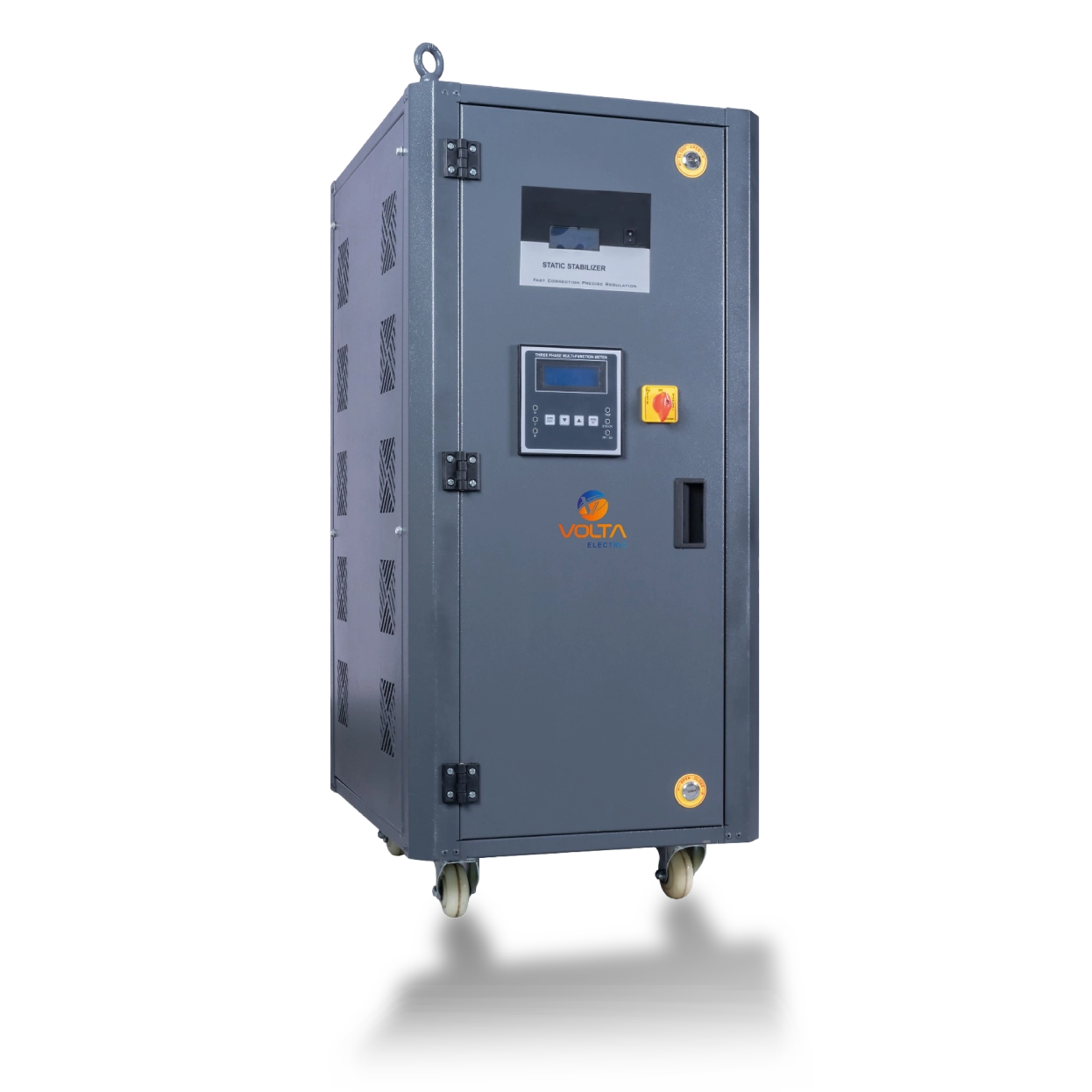
Static Stabilizer
Static stabilizers from Volta Green Energy Pvt. Ltd. deliver rock-solid voltage regulation across a huge range of capacities of 3-Phase systems from 10 kVA to 200 KVA .So, your sensitive equipment always gets the steady power it deserves.

Quick Response
Corrects voltage in under 20 ms, contactless & reliable.
Air Cooled
Efficient, silent operation with natural cooling.
Accurate Control
DSP-based system maintains voltage within ±1%.
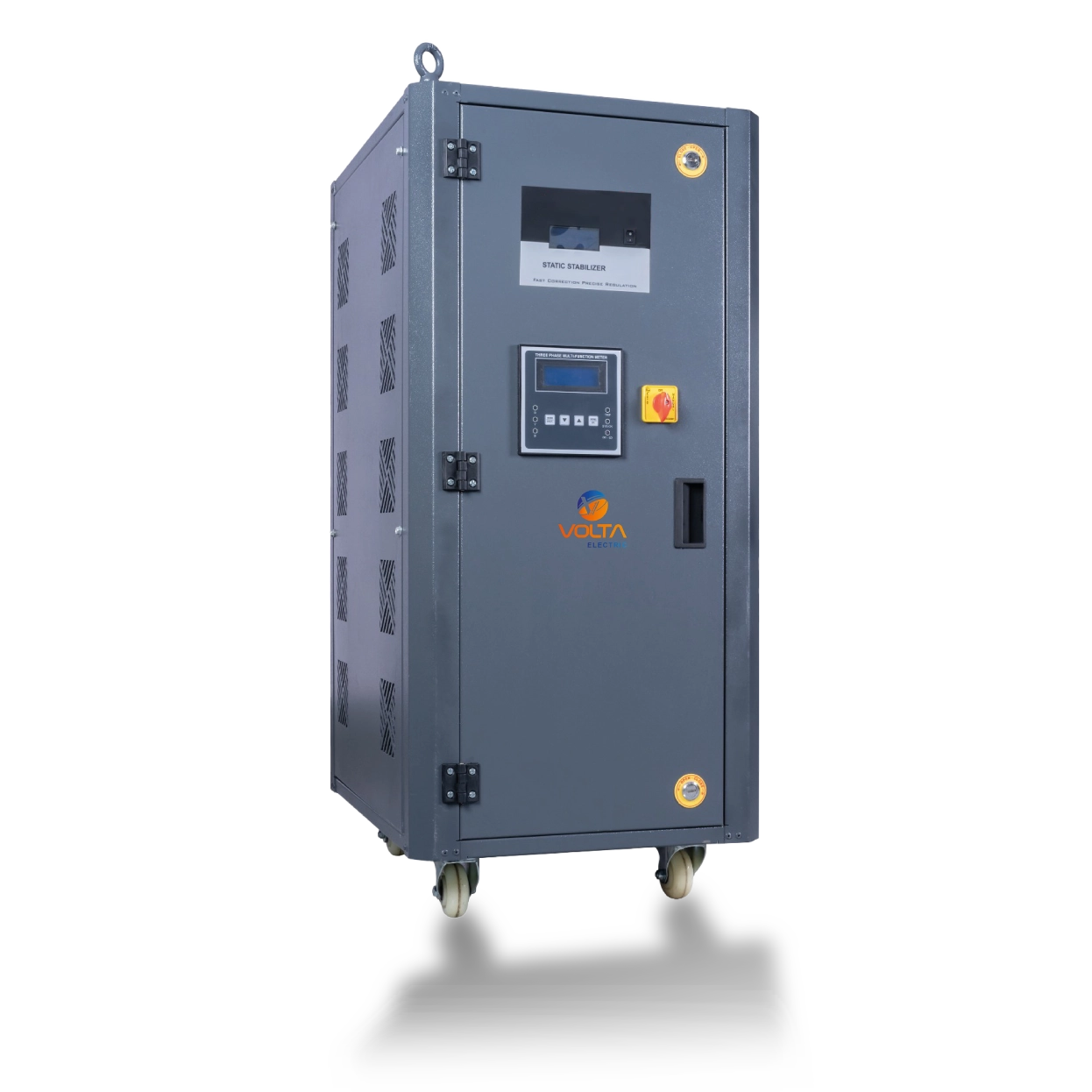
10KVA–60KVA Static Stabilizer
Three Phase | Air Cooled | VGES -
10 / 15 / 20 / 25 / 30 / 40 / 50 / 60 KVA
Microprocessor-Based Regulation
Silent Static Operation
High Voltage Accuracy ±1%
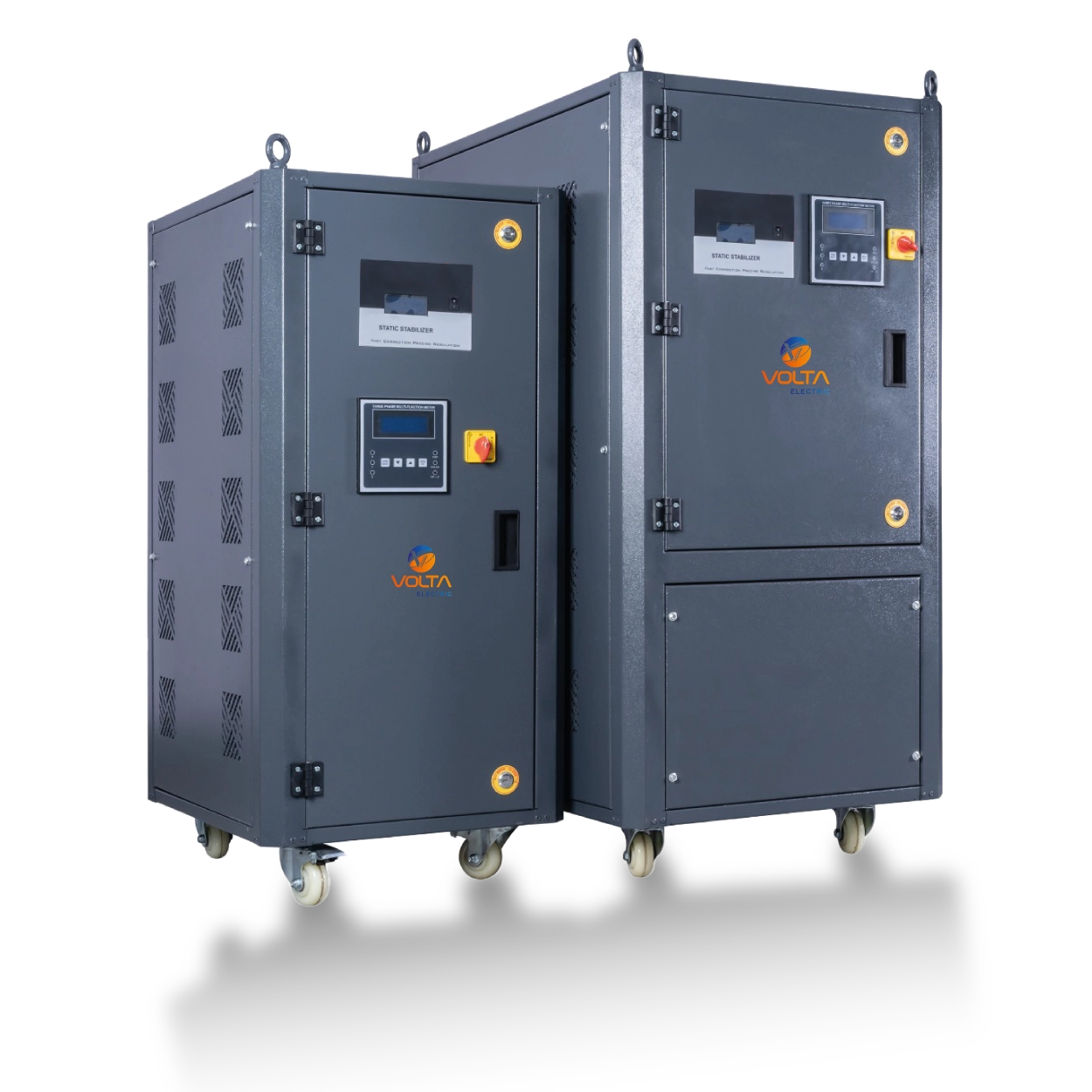
60KVA–200KVA Static Stabilizer
Three Phase | Air Cooled | VGES -
60 / 75 / 100 / 125 / 150 / 175 / 200 KVA
Fast Correction Speed
Pure Sinewave Output
Maintenance-Free Operation
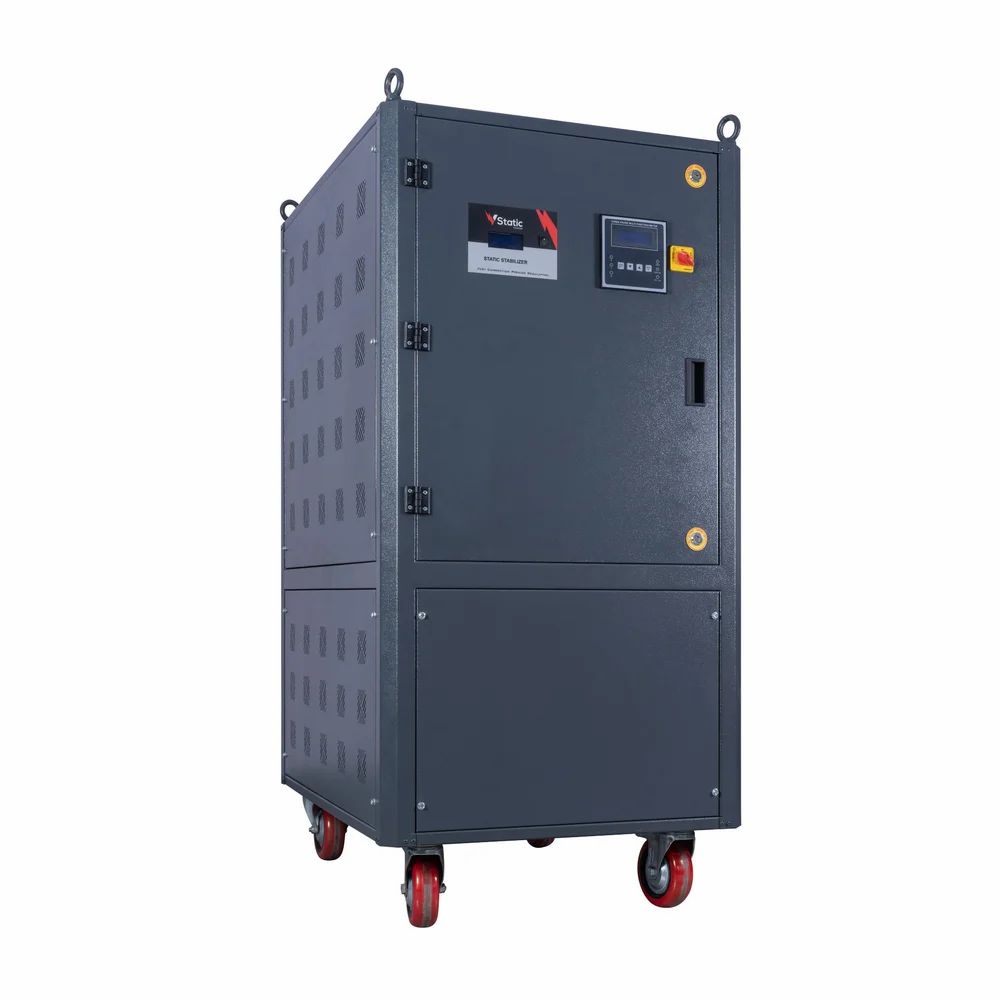
Static Stabilizer
Static stabilizers from Volta Green Energy Pvt. Ltd. deliver rock-solid voltage regulation across a huge range of capacities of 3-Phase systems from 10 kVA to 200 KVA .So, your sensitive equipment always gets the steady power it deserves.
Range
3 Phase – Air Cool (10 KVA to 60 KVA)
3 Phase – Oil Cool (60 KVA to 200 KVA)
Accurate Control
DSP-based system maintains voltage within ±1%.
Quick Response
Corrects voltage in under 20 ms, contactless & reliable.
Air Cooled
Efficient, silent operation with natural cooling.
Got Questions?
We are here to assist you. Feel free to call or email us with any solar-related queries at any time.
+91 72280 10925
[email protected]
Static Stabilizer for B2B Businesses in Gorakhpur
Advanced Static Voltage Stabilizers for Industries and Businesses in Gorakhpur
Reliable electricity is essential for businesses that depend on machinery, automated systems, and sensitive electronic equipment. In Gorakhpur, where industrial units, food-processing businesses, commercial establishments, hospitals, and manufacturing facilities contribute to the local economy, maintaining a stable power supply is important for smooth day-to-day operations.
Voltage fluctuations can create problems that are not always immediately visible. Machines may stop unexpectedly, electronic controllers may malfunction, and production schedules can be disrupted. For businesses operating equipment that requires a consistent voltage supply, these interruptions can lead to additional maintenance costs and unnecessary downtime.
Volta Green Energy Pvt. Ltd. offers static stabilizer solutions designed to provide fast and precise voltage regulation for suitable industrial and commercial applications. Using solid-state electronic control technology, static stabilizers help maintain a stable output voltage within the specified operating range of the selected model.
Whether you operate a manufacturing unit in GIDA (Gorakhpur Industrial Development Authority), a food-processing facility near Sahjanwa, a workshop in Gorakhpur city, or a commercial establishment serving the surrounding region, choosing the right static voltage stabilizer can help support reliable equipment performance.
What Is a Static Stabilizer?
A static stabilizer is an electronic voltage regulation device that monitors incoming electrical voltage and corrects variations using semiconductor-based power electronics and electronic control circuits.
Unlike a traditional servo stabilizer, which uses a motor-driven mechanical mechanism to adjust voltage, a static stabilizer performs voltage correction electronically. This design can deliver a faster response and eliminates the motor-driven mechanism used for voltage adjustment in servo stabilizers.
For businesses in Gorakhpur, static stabilizers can be useful where sensitive equipment, automated machinery, or electronic control systems require accurate voltage regulation. Volta Green Energy’s referenced product range includes three-phase static stabilizers from 10 kVA to 200 kVA, with air-cooled configurations and other options depending on the selected model. The right choice depends on the connected load, incoming voltage conditions, and the requirements of the application.
Why Do Businesses in Gorakhpur Need Static Stabilizers?
Gorakhpur has a varied business environment, including industrial manufacturing, food processing, healthcare, commercial operations, and engineering-related activities. Many of these businesses use equipment that must operate within defined electrical limits.
For example, a manufacturing unit may depend on motors, control panels, and production machinery, while a hospital may require a stable supply for laboratory instruments and sensitive electronic equipment. When voltage fluctuates beyond acceptable limits, businesses may experience:
Unexpected machine shutdowns and production interruptions.
Malfunctions in PLCs, controllers, and electronic control panels.
Unstable operation of precision equipment.
Increased troubleshooting and maintenance requirements.
Interruptions to packaging, processing, and manufacturing activities.
Potential damage to connected equipment during abnormal voltage conditions.
Delays in production schedules and customer deliveries.
A properly selected static stabilizer helps regulate voltage within its designed operating limits. This can reduce problems associated with voltage variations, although actual performance depends on the incoming supply, connected load, and stabilizer specifications.
It is important to understand that a static stabilizer does not provide backup power during a complete electricity outage. Businesses that require uninterrupted operation may also need a UPS, generator, or another suitable backup solution.
Key Benefits of Static Stabilizers for Gorakhpur Industries
1. Fast Voltage Correction
Static stabilizers use electronic power regulation technology to respond rapidly to changes in incoming voltage. Depending on the model and operating conditions, voltage correction may take place within milliseconds.
This is particularly useful for applications where voltage disturbances can affect sensitive electronics, automation systems, and production equipment.
2. Precise Voltage Regulation
Electrical equipment generally performs best when supplied with voltage within its specified operating range. Volta’s referenced static stabilizer specifications include digital signal processor (DSP)-based control with regulation accuracy of up to ±1% under specified conditions.
The actual regulation accuracy should be confirmed against the selected model’s datasheet and operating conditions.
3. Reduced Mechanical Maintenance
Static stabilizers do not use the motor-driven mechanical voltage-adjustment mechanism found in conventional servo stabilizers. This reduces the maintenance associated with those moving voltage-correction components.
However, routine inspection of electronic components, cooling arrangements, electrical connections, and protection systems remains important.
4. Support for Sensitive Equipment
Industrial facilities, hospitals, laboratories, and commercial businesses often use equipment that requires stable electrical input.
A correctly selected static stabilizer can help maintain suitable voltage conditions for compatible machinery, control systems, testing instruments, and electronic devices.
5. Reduced Voltage-Related Downtime
When voltage fluctuations interrupt equipment operation, businesses can lose valuable production time. Repeated machine restarts, troubleshooting, and interrupted processes can affect productivity.
A suitable static stabilizer can help reduce interruptions caused by voltage variations and support smoother daily operations.
6. Compact Design and Suitable Cooling Options
Depending on the model, static stabilizers can offer compact installation arrangements and air-cooled configurations. These may be suitable for facilities where installation space and maintenance access are important considerations.
The selected model should be installed with adequate ventilation and suitable protection against dust, heat, and other environmental conditions.
7. Long-Term Operational Value
A stabilizer should be evaluated not only on its purchase price but also on its suitability for the connected load, maintenance requirements, and the potential cost of voltage-related interruptions.
Selecting the correct capacity and technical configuration can help businesses make a more informed investment in electrical reliability.
Key Features to Look for in a Static Voltage Stabilizer
When selecting a static stabilizer in Gorakhpur, businesses should evaluate the technical specifications carefully. A model that works well for one application may not be suitable for another.
Advanced Solid-State Technology
Electronic voltage regulation allows the stabilizer to correct supply variations without relying on a motor-driven mechanical adjustment mechanism.
This can be beneficial for applications where quick voltage correction is an important requirement.
Digital Control System
A digital or DSP-based control system monitors electrical conditions and manages voltage correction. Depending on the model, it may also support fault monitoring, operating status indications, and protective functions.
Fast Response Time
Some static stabilizers are designed to correct voltage variations within milliseconds. Always verify the specified response time and the conditions under which it is measured before selecting a model for sensitive equipment.
Suitable Input Voltage Range
The stabilizer should be able to accommodate the voltage fluctuations experienced at your premises. Check its specified input voltage range and confirm whether its output capacity or regulation accuracy changes at extreme input voltages.
Appropriate Overload Capability
Motors, pumps, compressors, and other equipment may draw additional current during startup. The stabilizer must be selected after considering starting current, overload duration, and the characteristics of the connected load.
Cooling and Installation Requirements
Check the available installation space, ventilation, ambient temperature, dust exposure, and accessibility for servicing. Proper installation helps maintain reliable operation.
Protection Functions
Depending on the model, protection features may include overvoltage, undervoltage, overload, short-circuit, phase-failure, and overtemperature protection. Confirm the included functions before purchasing.
Static Stabilizer Models and Capacity Options
Volta Green Energy’s referenced product range covers three-phase static stabilizers in the following capacity groups.
| Product category | Capacity options |
|---|---|
| Three-phase, air-cooled static stabilizer | 10, 15, 20, 25, 30, 40, 50 and 60 kVA |
| Three-phase static stabilizer, higher-capacity range | 60, 75, 100, 125, 150, 175 and 200 kVA |
The available cooling arrangements, protection functions, and electrical specifications may vary by model. Please confirm current availability and the required configuration with Volta Green Energy before placing an order.
How Much Static Stabilizer Capacity Does Your Business Need?
Choosing the right capacity is an important step. The stabilizer must be capable of handling the connected load while accounting for power factor, starting current, voltage variation, and operating conditions.
The following table provides indicative capacity groups for initial consideration. It is not a substitute for a proper electrical load assessment.
| Application | Capacity range to assess |
|---|---|
| Small commercial equipment or selected sensitive loads | 10–20 kVA |
| Workshops and smaller production equipment | 20–30 kVA |
| Medium-sized machinery and commercial loads | 30–60 kVA |
| Larger industrial equipment and grouped loads | 75–100 kVA |
| Higher-demand industrial installations | 125–200 kVA |
For instance, a machine with a 30 kW rating does not automatically require a 30 kVA stabilizer. The actual requirement depends on power factor, efficiency, startup current, and the characteristics of the electrical load.
For installations involving multiple machines, a qualified electrical professional should calculate the total demand and determine the appropriate stabilizer capacity.
Essential Protection Features for Industrial Applications
A static stabilizer should include protection functions suitable for the equipment and electrical conditions at the installation site.
| Protection feature | Purpose |
|---|---|
| Overvoltage protection | Helps protect connected loads against excessive output voltage. |
| Undervoltage protection | Helps prevent operation outside permitted low-voltage limits. |
| Overload protection | Responds when the connected load exceeds specified limits. |
| Short-circuit protection | Supports a safe response to short-circuit conditions as designed. |
| Phase-failure protection | Detects a missing phase in applicable three-phase systems. |
| Phase-sequence protection | Identifies incorrect phase sequence where supported. |
| Overtemperature protection | Helps prevent operation beyond specified thermal limits. |
| Input supply monitoring | Monitors incoming electrical conditions. |
| Surge protection | Addresses specified transient overvoltage events when included in the design. |
Not every static stabilizer includes all these features. The actual protection package should be verified from the approved technical datasheet.
Suitable earthing, circuit protection, and external surge protection may also be necessary depending on the site. A static stabilizer does not automatically resolve every power quality issue, such as harmonic distortion, frequency variation, or complete power failure.
Applications of Static Stabilizers Across Gorakhpur
Manufacturing Units in GIDA and Sahjanwa
Manufacturing facilities often rely on motors, production machines, electrical panels, and automated control systems. Voltage fluctuations can interfere with machine operation and cause avoidable production interruptions.
A suitably rated static stabilizer can help maintain voltage within the required limits for compatible equipment and support more consistent manufacturing operations.
Food Processing and Packaging Businesses
Food-processing facilities may use pumps, conveyors, mixers, refrigeration controls, filling systems, and packaging machines.
Voltage regulation can support the reliable operation of compatible equipment. The stabilizer must be selected according to the electrical characteristics of the connected machinery, including motor starting current and continuous operating load.
Engineering Workshops and Fabrication Units
Engineering workshops may use cutting machines, drilling equipment, welding-related controls, compressors, and electronically controlled tools.
Where voltage variations affect connected machinery or electronic controls, a suitable stabilizer may help maintain a more consistent supply. Welding equipment and other high-current or fluctuating loads require particular attention during sizing.
Hospitals and Diagnostic Centres
Hospitals, clinics, and diagnostic centres use laboratory instruments, diagnostic systems, monitoring devices, and other sensitive electrical equipment.
These applications require careful consideration of voltage accuracy, electrical safety, and equipment manufacturers’ specifications. Critical medical equipment may require a dedicated UPS or backup power arrangement in addition to voltage regulation.
Commercial Buildings and Offices
Offices, retail establishments, educational institutions, and commercial buildings may operate computers, servers, networking equipment, access control systems, and electronic controls.
A static stabilizer can be considered where voltage regulation is required for compatible equipment. For larger buildings, separate stabilizers for specific load groups may be more appropriate than a single unit for the entire premises.
Warehouses and Logistics Facilities
Warehouses and distribution centres may depend on conveyors, material-handling equipment, electronic controls, and IT systems.
A suitable voltage regulation solution can help support the operation of compatible equipment, particularly where voltage disturbances contribute to unexpected interruptions.
Laboratories and Testing Facilities
Laboratories and testing facilities often use instruments that require a stable electrical supply to produce consistent results.
A properly selected static stabilizer can help maintain voltage within the specified range. Equipment sensitivity, grounding requirements, and any additional power quality requirements should be evaluated before installation.
Static Stabilizer vs. Servo Stabilizer
Static and servo stabilizers both regulate voltage, but they use different technologies. Understanding the difference helps businesses choose the right solution for their requirements.
| Parameter | Static stabilizer | Servo stabilizer |
|---|---|---|
| Voltage correction | Electronic, solid-state regulation | Motor-driven mechanical regulation |
| Response speed | Can provide correction within milliseconds, depending on design | Generally slower, depending on design |
| Mechanical voltage-correction parts | No motor-driven correction mechanism | Uses moving mechanical components |
| Maintenance | Lower mechanical maintenance requirements | Requires maintenance of mechanical components |
| Voltage accuracy | Depends on model and operating conditions | Depends on model and operating conditions |
| Suitable applications | Loads where fast correction is important | Many general industrial and commercial loads |
| Initial investment | May be higher for some configurations | May be more economical for some applications |
A static stabilizer may be preferable when fast electronic correction and reduced mechanical maintenance are priorities. A servo stabilizer can remain a suitable option for many general-purpose industrial applications.
The best choice depends on the connected load, input voltage variation, required accuracy, response time, and total cost of ownership.
How to Choose the Right Static Stabilizer in Gorakhpur
Before investing in a static voltage stabilizer, assess the electrical conditions and operating requirements of your facility.
Measure incoming voltage: Check voltage variations under different operating conditions and at different times of the day.
Identify critical equipment: List the machines, instruments, and electronic systems that require stable voltage.
Calculate the connected load: Consider kW, kVA, power factor, efficiency, and starting current.
Confirm phase requirements: Determine whether a single-phase or three-phase stabilizer is required.
Check regulation accuracy: Match the specified output accuracy and response time to the equipment requirements.
Verify protection functions: Review overload, overvoltage, undervoltage, phase, and temperature protection.
Evaluate the installation environment: Consider ambient temperature, ventilation, dust, humidity, and available space.
Review technical support and warranty: Confirm installation guidance, warranty terms, and maintenance arrangements.
Compare total ownership cost: Consider the purchase price, maintenance requirements, operating conditions, and potential downtime.
A qualified electrical professional can assess your site conditions and help determine the correct stabilizer capacity and configuration.
Why Choose Volta Green Energy for Static Stabilizer Solutions?
Selecting a voltage stabilizer is about more than choosing a product with the right kVA rating. It is about finding a solution that matches your equipment, electrical conditions, and operating requirements.
Volta Green Energy Pvt. Ltd. offers static stabilizer solutions for industrial and commercial applications, with a referenced three-phase product range covering capacities from 10 kVA to 200 kVA.
When evaluating a Volta static stabilizer for your Gorakhpur facility, you can discuss:
Capacity selection based on your connected load.
Voltage regulation accuracy and response-time requirements.
Available air-cooled and other configurations.
Protection features and electrical specifications.
Installation and operating requirements.
Warranty terms and available technical support.
Our objective is to help businesses identify suitable voltage regulation solutions based on their actual requirements, rather than recommending a model without understanding the application.
To help us assess your requirements, share your connected load, incoming voltage range, phase configuration, and equipment details with our team.
Protect Your Business with a Reliable Static Stabilizer in Gorakhpur
From manufacturing units in GIDA to food-processing facilities, hospitals, workshops, and commercial establishments, businesses across Gorakhpur rely on electrical equipment to maintain productivity and meet daily commitments.
Voltage fluctuations can create unnecessary challenges, particularly when sensitive electronics, automated controls, and production machinery are involved. A properly selected static stabilizer helps regulate voltage, supports the reliable operation of compatible equipment, and can reduce interruptions caused by voltage variations.
Volta Green Energy provides static stabilizer options for businesses seeking dependable voltage regulation and application-specific technical guidance.
Request a Consultation for Static Stabilizers in Gorakhpur
Looking for a static voltage stabilizer for your factory, workshop, hospital, laboratory, warehouse, or commercial establishment in Gorakhpur?
Contact Volta Green Energy Pvt. Ltd. to discuss your electrical load and identify a suitable static stabilizer solution.
Contact Volta Green Energy Pvt. Ltd.
Phone: +91 9292 81 9292
Email: [email protected]
Website: https://voltagreenenergy.in/
Choose the right voltage regulation solution to help protect compatible equipment, support operational reliability, and keep your business running smoothly.
Frequently Asked Questions (FAQs)
1. What is a static stabilizer used for?
A static stabilizer regulates incoming voltage electronically to maintain a more consistent output within its specified operating limits. It is used with compatible industrial machinery, electronic controls, commercial equipment, and other loads that require stable voltage.
2. Which static stabilizer is suitable for an industrial unit in Gorakhpur?
The appropriate model depends on your connected load, input voltage range, phase configuration, motor starting current, and required output accuracy. Volta Green Energy’s referenced three-phase range includes capacities from 10 kVA to 200 kVA.
3. What is the difference between a static stabilizer and a servo stabilizer?
A static stabilizer uses electronic power components for voltage regulation, while a servo stabilizer uses a motor-driven mechanical mechanism. Static stabilizers can offer faster correction and reduced mechanical maintenance, while servo stabilizers can be suitable for many general-purpose industrial applications.
4. Can a static stabilizer be used with CNC machines and automated equipment?
Yes, a suitably specified static stabilizer may be used to regulate voltage for compatible CNC machines and automated equipment. However, the final selection must account for starting current, load characteristics, manufacturer requirements, and any additional power quality concerns.
5. Does a static stabilizer provide power backup during an electricity outage?
No. A static stabilizer regulates voltage while an adequate incoming supply is available. If equipment must continue operating during a power failure, a UPS, generator, or another suitable backup system is required.
6. Does Volta Green Energy offer high-capacity static stabilizers?
The referenced product range includes three-phase static stabilizers up to 200 kVA. Contact Volta Green Energy to confirm current availability, technical specifications, cooling arrangements, and suitability for your application.
7. How do I calculate the required stabilizer capacity?
Start by evaluating the connected load, power factor, motor starting current, incoming voltage conditions, and equipment sensitivity. A qualified electrical professional can help calculate the required kVA capacity and verify the manufacturer’s specifications.
8. How can I get a quotation for a static stabilizer in Gorakhpur?
Contact Volta Green Energy at +91 9292 81 9292 or [email protected]. Share your application, connected load, input voltage range, and phase requirements so the team can help identify a suitable option.